“The first principle is that you must not fool yourself — and you are the easiest person to fool.”

Richard Feynman

How we work

Four moves, one loop, and a record of what didn’t work.

A method is only worth having if it can tell you that you were wrong.

01EmpathiseData to insight
02StrategiseInsight to choices
03RealiseChoices to impact
04AnalyseImpact to evidence

Most people decisions are made on consensus. The loudest voice in the room, the priority that arrived with this year’s trend reports, the initiative that happens to have a sponsor. Each is defensible in the moment. None of them is evidence.

The People Centricity Methodology™ is what we use instead. Four moves turning what people say and do into insight, insight into choices, choices into measured impact — and impact back into evidence.

Not new, and not one thing. Design thinking frames the problem, lean experimentation tests the answer, human capital measurement proves the result. We have run them as one loop since 2006.

Let’s talk No pitch. A conversation about your situation.

Why the first move matters

Most work that fails solved the wrong problem.

Not badly executed. Well executed, against a problem statement nobody tested. The research on this is unusually consistent, and executives are the ones reporting it.

Named by executives60%of more than 700 international executives put poor problem formulation among the two biggest barriers to solving problems in their organisation.
Decisions studiedHalfof 350 decision processes in medium and large companies failed to achieve the intended result — often because time pressure cut the examination of the problem short.
The other barrierStakeholdersInsufficient stakeholder engagement was named alongside it. Framing done alone, or with people who already agree, is the second half of the same failure.

Chevallier, Enders & Barsoux, 2023 · Nutt, reported in Binder & Watkins, 2024 · Both samples are executives in management-education settings, and the first figure is self-reported

The same three errors keep appearing. They are worth naming, because each one is invisible from inside it.

  • Assuming everyone sees the same problem. We overestimate how far others share our reading of a situation — the false consensus effect — so the framing is never tested against the people it affects.
  • Framing that is really a solution in disguise. Ask how to increase parking capacity and you have already ruled out reducing demand. A frame that is too narrow forecloses the alternatives; one that is too broad spreads attention across things that do not matter.
  • Deciding the frame alone, or among people who agree. Objections then arrive from stakeholders whose support was assumed, at the point where a solution has already been chosen and defended.

This is why Empathise is a move rather than a preliminary. It goes to the people who do the work as well as the people who commission it, it triangulates what they say against what the data shows they do, and it ends on a problem statement both recognise — not on agreement about the answer, but agreement about the question.

Everything after it is only as good as that statement. A method that gets this wrong produces well-governed, carefully measured delivery of the wrong thing.

Binder, J., & Watkins, M. D. (2024). To solve a tough problem, reframe it. Harvard Business Review, 102(1). Chevallier, A., Enders, A., & Barsoux, J.-L. (2023). Become a better problem solver by telling better stories. MIT Sloan Management Review, 64(3), 73–78.

The loop

Four moves around four states.

One loop, not two. The moves are what we do. The states are what the evidence is at each point.
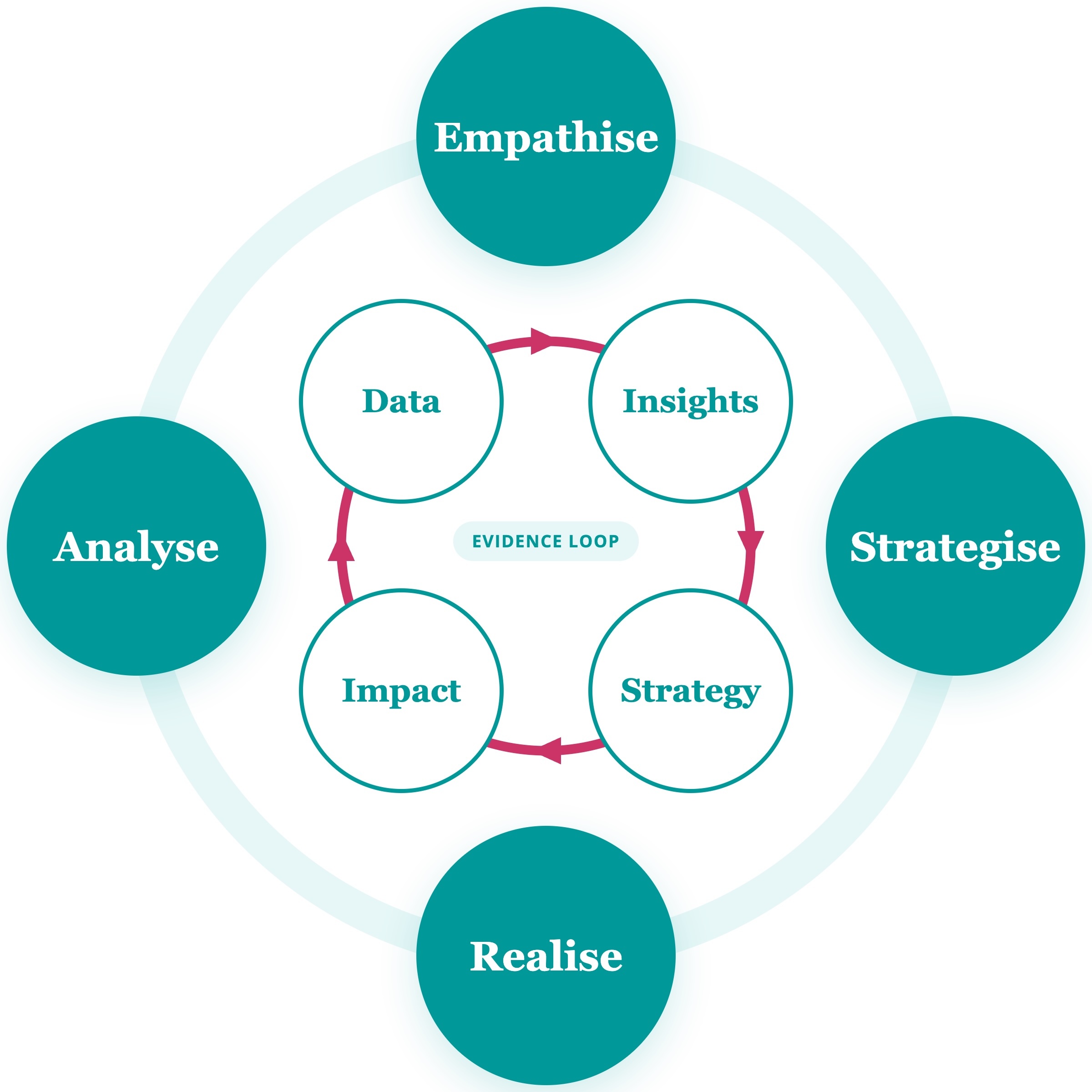
The People Centricity Methodology: Empathise, Strategise, Realise and Analyse arranged around four inner states — Data, Insights, Strategy and Impact.

Outer ring: the four moves. Inner ring: the four states each move converts.

Read the diagram from the inside out. The inner ring is the evidence itself, in four states: Data, Insights, Strategy, Impact. The outer ring is the four moves that convert one state into the next.

Each move owns exactly one conversion, so there is no move without a state change and no state change without a move. Empathise turns Data into Insights, Strategise turns Insights into Strategy, Realise turns Strategy into Impact. If a piece of work cannot be placed on the ring, it is not part of the engagement.

The fourth conversion is what makes it a loop rather than a line. Analyse turns Impact back into Data, so each turn starts better informed than the last. Break that return and you have either analytics that change nothing, or a strategy that cannot learn.

How the loop turns

Each move advances the loop by a quarter turn.

What happens in each move, what you hold at the end of it, and the condition that has to be met before the next one starts.

01

Empathise

Data → Insights. Understand before prescribing.

We start with the people who do the work. Interviews, focus groups and surveys alongside the numbers already in your systems — HRIS records, exit and mobility data, absence, cost. Nothing is concluded from a single signal.

Read more

The distinction that matters here is direct against indirect. Self-report tells you what people believe and are willing to say out loud. Behavioural data tells you what they actually did and never explains why. Each one is insufficient alone, and each one fails in a different direction, which is exactly why we hold them against each other.

The output is not a report. It is an agreed problem statement — one the executive team and the workforce both recognise, which is harder than it sounds and is usually where the first surprise arrives.

In practice

Name the one question this turn of the loop has to answer, then gather only the evidence that answers it. Everything else is collection for its own sake.

What you hold
  • An agreed problem statement — recognised at executive level and on the floor
  • The evidence base, source by source — with each finding traceable to what produced it
  • The divergence map — where expectations and organisational reality pull apart
Moves on whenThere is a problem statement both the executive team and the workforce recognise. Not agreement on the answer — agreement on the question.
02

Strategise

Insights → Strategy. Turn insight into choices.

We separate the priorities that decide the future from the ones that are merely loud, and size the investment to the measured gap rather than to the ambition. Objectives, roadmap, risks and an investment case follow, each one traceable to a specific piece of evidence from the move before.

Read more

A strategy is a set of bets about what will move the business through its people. Bets have odds, and the honest version of this work states them. Where a finding is correlational rather than causal, the objective built on it carries that limitation into the business case instead of quietly dropping it.

This is also where things get taken out. A strategy that keeps every initiative that arrived with a sponsor has made no choices at all.

In practice

List the strategy’s leap-of-faith assumptions, rank them by how much rests on them, and test the riskiest before committing budget to any of it.

What you hold
  • Strategic objectives with success measures — two per objective, each tested for relevance and for whether you can actually collect it
  • A roadmap — sequence, owners, decision points and dependencies
  • An investment case — the gap it closes, what it costs, and what it is expected to return
Moves on whenEvery objective traces to a named piece of evidence, and anything that traces to nothing has been removed.
03

Realise

Strategy → Impact. Make it real, and make it yours.

Strategy becomes a decision-ready design: operating model, sequencing, governance and success measures defined before anything starts moving. We hold the programme office and the change office. The delivery streams underneath belong to your teams or your implementation partner.

Read more

That split is deliberate and it costs us the largest part of the revenue in this work. It also removes the reason to recommend a build. There is no follow-on engagement for our advice to bend towards, because we do not sell one.

Baselines are set here, before the first initiative launches. A baseline recorded afterwards is not a baseline, it is a reconstruction, and it can be made to say almost anything.

In practice

Prove it with a minimum viable pilot — one cohort, one directorate, one country — before any organisation-wide rollout.

What you hold
  • Operating model and governance — who decides what, and at which forum
  • Project charters — owners, resources, milestones, KPIs, risks and dependencies
  • Baselines, recorded before launch — the numbers the result will be judged against
Moves on whenThe work is running under your governance, with baselines recorded and dated ahead of the first initiative.
04

Analyse

Impact → Data. Measure, learn, return.

We track outcomes against the baselines set in Realise and report them in full — including the ones that did not move, and our reading of why. Then the findings go back in, and the next Empathise starts from them.

Read more

Reporting only what improved is the most common failure in this field, and it is not usually dishonesty. It is the natural consequence of measurement that begins once the result is already known. Setting the baseline first is what makes a negative result reportable rather than embarrassing.

Analysis is not the end of the work. It is the start of the next turn, which is why Analyse and Empathise touch on the diagram.

In practice

Treat each turn as an experiment. Set the baseline, try to move it, then decide — continue, adjust or stop. Reporting a number without a decision attached changes nothing.

What you hold
  • Measured outcomes against baseline — objective by objective
  • What did not move — stated plainly, with our reading of the cause
  • The evidence base for the next turn — this year’s impact as next year’s data
Doesn’t closeAnalyse is the only move with no exit. Its output is the input to Empathise, which is what makes this a loop rather than a project.

The four states

What the loop converts.

Data → Insights → Strategy → Impact → Data

The moves are verbs. These are the nouns they act on. Naming them separately matters because most people work stalls at a state change rather than inside a move — evidence that never becomes insight, insight that never becomes a choice, a choice that is never measured.

01DataThe raw evidence. What people say, what they do, and the numbers already sitting in your systems.
02InsightsWhat that evidence means once triangulated and stripped of assumption. A finding, not a chart.
03StrategyThe choices that follow. Priorities, sequencing and investment, each tied back to a specific finding.
04ImpactWhat changed for the organisation and the people in it, measured against a baseline set beforehand.

Why a loop and not a line. A line ends at Impact, and a strategy that ends at Impact has no way of finding out whether it was right. Impact becoming Data is what makes evidence compound — decisions get sharper because the ground under them is firmer, not because anyone got cleverer.

Where it comes from

Not invented here. Assembled, and credited.

Three bodies of work, none of them ours. What makes the combination worth more than the parts is that each one fails on its own in a way the other two prevent.

1962

Design methods

The Conference on Design Methods at Imperial College is generally treated as the start of modern design methodology, and of what later became design thinking (Jones & Thornley, 1963). Its argument was that designing could be made systematic without ceasing to be human, and that the problem has to be understood before it is solved.

What we tookUnderstand before prescribing. Empathise exists because of this.
1977

Human capital measurement

Jac Fitz-enz founded the Saratoga Institute and spent a career on one question: what value do people create, and how would you know? He made the measurement of people work a discipline rather than an opinion.

What we tookBaselines before the work, and two metrics per objective. Analyse exists because of this.
2011

Lean experimentation

Ries took the same instinct into conditions of high uncertainty and called the result validated learning: test the assumption you are least sure of, at the smallest scale that would tell you anything, before committing to it.

What we tookThe three habits below, and the pilot before the rollout.

Why all three

Taken separately, each of these has a well-known failure mode. That is the argument for the combination, and it is not a rhetorical one.

  • Design thinking on its own can frame a problem beautifully and never establish whether solving it changed anything. Empathy without measurement produces work that feels right and cannot be checked.
  • Lean experimentation on its own iterates quickly towards a goal nobody stopped to question. Fast, disciplined testing of the wrong assumption is still the wrong assumption, arrived at sooner.
  • Measurement on its own establishes what happened and says nothing about what to do next. It is why so much people analytics reports precisely and changes nothing.

Each failure is one of the others’ specialities. Framing gives measurement something worth measuring. Measurement gives framing a way to be proved wrong. Testing stops either of them committing before it knows.

Which is why the four moves are a loop rather than a sequence of three methods run in order. Separate them and you get the failure modes back, one at a time.

Three habits that keep it honest

Borrowed from Ries, and the reason the loop does not run on good intentions.

  • Actionable metrics, not vanity onesCohort-based, causal measures over aggregate numbers that flatter the function and guide no decision.Without it: a dashboard reviewed monthly and acted on never.
  • A scheduled pivot-or-persevere callAt the close of each turn, every objective gets an explicit decision — continue, adjust or stop — scheduled in advance so that not deciding is not an option.Without it: initiatives that die of attendance, never having been stopped by anyone.
  • Root cause before remedyTrace the problem to its cause before sizing a response, so the investment matches the cause rather than the symptom.Without it: money spent on the thing that was easiest to see.

Jones, J. C., & Thornley, D. G. (Eds.). (1963). Conference on design methods. Pergamon Press. Ries, E. (2011). The lean startup: How constant innovation creates radically successful businesses. Crown Business.

What holds it together

Four principles.

The loop is the mechanism. These are the commitments that decide how it gets run once the work becomes uncomfortable.

Evidence over consensus

Every choice traces to data, not to the loudest voice in the room or the year’s headlines.

Human-centred

Grounded in human-centred design and behavioural science. The people who do the work are consulted first, not validated last.

Independent

No vendor partnerships and no delivery streams. There is no follow-on engagement for our recommendations to bend towards.

Honest measurement

Baselines up front, results reported in full, and limitations stated where a finding is correlational rather than causal.

Where it runs

The same loop, at two sizes.

We have two offerings. Both run this method. What changes is the size of the question and how long we stay.

Continuity

People Strategy

The whole agenda. All four moves, run across three stages — Define, Activate, Prove — as one continuous commitment rather than three engagements. We stay until the board has seen what it returned.

Empathise and Strategise in Define · Realise in Activate · Analyse in Prove

Containment

People Centricity

One bounded problem, solved precisely. The same four moves, at a smaller radius, with a stated end condition for each stage. It finishes, and finishing is the point.

The full loop, one turn, on a single question

Work with us

Bring us a question the evidence can settle.

The method is published so you can judge it before you meet us. What it cannot tell you is whether it fits your situation, and that is a conversation rather than a page.

Most first calls are spent on what is breaking, what you have already tried, and what your own evidence is telling you. Some end with a proposal. Many end with a suggestion and nothing else.

We work with a small number of clients at any one time.

Not at that point yet? Start with the 2026 HR Trends and Priorities Heatmap — ten trend reports read side by side, fully sourced, with every ranking movement set out in full. It is the evidence we would open a first conversation with.

Who’s behind this

Tanguy Dulac

Tanguy Dulac

Founder & Managing Partner, PeopleCentriX

PhD, Management Science — LSE / UCLouvain
Doctoral research — psychological contract fulfilment and breach
MSc Applied Economics — UCLouvain
MSc Psychology — UCLouvain
Academy of Management Journal — cited 1,000+ times
Lecturer — Sustainable Human Capital Management, University of Fribourg
Lecturer — Human Capital Risk Management, HEG Genève

Most of the work I am called about arrives as a solution already chosen. Behind it there is either no problem statement at all, or one built on a single survey, one function’s view of itself, or an assumption nobody remembers questioning. Both routes end the same way: a solution delivered well, to a problem that was not the problem. It is the most expensive error in this field and the least often detected, because nothing was measured before it started.

I did not learn to work this way in consulting. A doctorate teaches you to treat your own intuition as a hypothesis, to state what evidence would change your mind before you go looking for any, to separate correlation from cause, and to hand the result to reviewers paid to find the flaw in it. That is not temperament. It is training, and it is the standard this method is held to.

My research was on the psychological contract: the distance between what people believe they were promised and what they actually receive. That distance is close to invisible from above, because the people who design an offer are the worst placed to describe what receiving it feels like. Which is why Empathise reaches the people doing the work before the people commissioning it.

One position, and I will defend it anywhere. Measurement that cannot embarrass you is not measurement. A loop that reports what did not move is worth more than one that only ever reports a return, because only the first can be believed. PeopleCentriX sells this work, so this page is not disinterested. It is checkable, which is the stronger claim and the harder one to fake.

If something here lands, or if it does not, say so.

STAY CONNECTED

People-Centric Insights.

Curated trends, thought leadership and case studies for leaders who make strategic decisions about people and experiences.