The essence of strategy is choosing what not to do”.

Michael Porter

People Strategy

Your people strategy. Defined, activated, and proven.

A list of initiatives is not a strategy. It is a record of who asked.

01DefineEvidence and case
02ActivateGovernance and delivery
03ProveMeasurement and ROI

Either there is no people strategy, or there is a document listing 20 initiatives — some borrowed from this year’s trend reports, some from whoever asked most persistently. It is defensible in every particular and it guarantees nothing. Nothing in it tells you which of the 20 will move the business, or the people in it.

We build the evidence base a strategy needs to survive a hostile question, the business case that gets it funded, and the governance that holds it together once the day job resumes.

Then we measure what it returned — and report what didn’t move.

Let’s talk No pitch. A conversation about your situation.

The mandate

The mandate is clear. The path is not.

Chief People Officers are handed an agenda that has to be strategically credible and financially justified, and delivered while the function keeps running. Three demands, one seat, and conditions that are not slowing down to accommodate any of it.

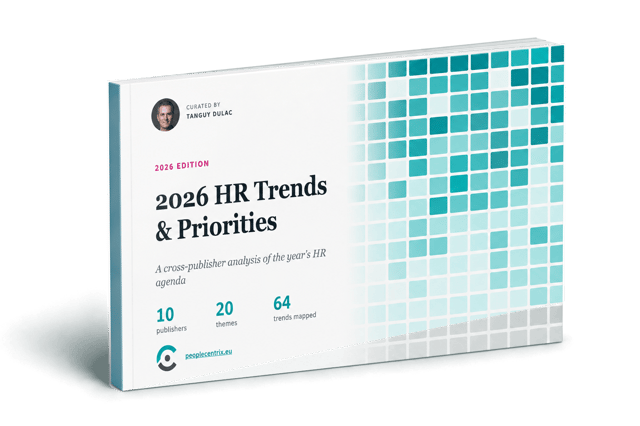
And this year the agenda arrived with an accelerant. Across the 10 trend reports behind our 2026 HR Trends & Priorities Heatmap, the share of trends framed through AI went from 11% to 75% in a single year. Every board now has an AI case that pays back by Friday: a number, a headcount, a line you can point to. People make their case slowly. When those two proposals compete for the same budget, only one arrives with a figure attached. We won’t tell you which platform to buy. Technology is an enabler, never a solution — deciding what the people function is for comes first, and it is the harder half.

9 of the 10 named the same top priority, and not one wrote a report about it: a clear HR value proposition, delivered through a fit-for-purpose operating model.

Even so, don’t build your agenda from them. We tested a set of board-approved people objectives against the consensus: 4 of 10 sat in the top 10 themes, 4 in the 11–20 band, 2 appeared nowhere. Half right — and nothing in the reports told you which half. Only your own evidence can.
The organisations we work with range from 500 to 50,000 people. Size has never been the qualifying criterion. What decides the work is how many geographies, how many businesses, and how much of the organisation the strategy has to move.

The evidence

Does it hold up? It does.

The link between people and performance is one of the most replicated findings in management research.

Consistency18 of 21 studies in top-ranked journals found a positive, statistically significant link between human capital and performance
MechanismHR practices build human capital; human capital produces performance. Only the first is a lever you hold
ContingencyHow strongly it holds depends on your labour market, structure, strategy and workforce

Performance there means delivery as well as profit — labour productivity, service quality, on-time delivery. So it holds for an organisation with a mandate as much as one with a share price.

And because the effect is contingent, a strategy lifted from another organisation inherits none of the conditions that made it work there. Which is also why we measure your baseline rather than quoting an average at you.

Giamos, D., & Stroehle, J. C. (2024). Revisiting human capital and firm performance: A systematic review (ORP Working Paper 2303). Oxford Initiative on Rethinking Performance, Saïd Business School, University of Oxford.
Schroders. (2023). Human capital management: Research summary — people are our greatest asset. Schroders, in collaboration with CalPERS and Saïd Business School, University of Oxford.

The business case

The business case for a strategic HR function.

Across more than 1,000 companies covering 26 million employees, Bersin finds that only a fraction run a strategic and systemic HR function — HR operating as one strategic system rather than a set of disconnected operational parts.

11%of HR functions are strategic and systemic.The other 89% are not.

Those that are:

Business outcomes

more likely to exceed financial targets
more likely to delight customers

People outcomes

12×more likely to reach high levels of workforce productivity
more likely to engage and retain talent

Adaptability

more likely to adapt well to change

Bersin, 2024

Note the shape of it. The financial multiples are the smallest on the list. Productivity, retention and adaptability run 4 to 6 times higher — which is the order the value arrives in. The money is downstream, and it is the last thing to move.

Bersin, J. (2024). The definitive guide to human resources: Systemic HR. The Josh Bersin Company.

Three questions

Three questions. If one of them stops you, that’s your entry point.

Not a menu. Three questions a Chief People Officer should be able to answer without preparation. Most can answer two.

Question one
What is our people agenda, and what has it delivered?
Exposure
Either nothing exists underneath the mandate, or what exists is a list assembled from trend reports and internal requests — defensible line by line, unprovable as a whole.
The tell
Three people in your leadership team describe the agenda three different ways, and all three are defensible.
The repair
Build the evidence, the strategy and the case — in that order, because reversing it is how strategies get written to justify decisions already taken.
Felt in the board meeting.
Question two
What have we stopped?
Drift
A strategy exists, and momentum has gone. Nothing was cancelled. Things simply stopped being discussed.
The tell
You cannot name the last initiative anyone formally closed, and the register still lists all of them as active.
The repair
Governance that meets, decides and records — held from inside the programme rather than advised on from beside it.
Felt by the workstream leads, long before it reaches you.
Question three
What did the investment return?
Silence
A strategy exists — running, or already delivered — and the metrics cannot answer the question the board is asking.
The tell
Your dashboard has more than 20 measures and not one of them has changed a decision this year.
The repair
Baselines set before the work starts, a KPI framework built to be acted on, and a value realisation report that reports what didn’t move.
Felt by the CFO, who stops asking.
Not ready for a conversation?The Chief People Officer Playbook — written for CPOs new to the seat, and for sitting CPOs whose mandate has changed under them. 24 pages, no form.
Read the Playbook

The engagement

Three stages. One continuous commitment.

Four weeks to build the plan with you, then three stages to run it — the same team throughout. An advisor who defines a strategy and hands it to someone else has no stake in whether it survives contact.

00

Scope

Four weeks. We build the plan with you — and both of us confirm the fit.

Every engagement is built rather than selected, so the first four weeks are spent building it — together. Not a proposal we hand over: a working session that runs until the plan is one you would defend to your own executive team. Two organisations of identical headcount need very different plans.

Read more

Four weeks is also long enough for both of us to find out whether this works. You are assessing us. We are assessing too — whether there is a sponsor who will spend political capital when the work gets uncomfortable, whether the organisation wants a change or a document, whether we will reach the people who hold the evidence.

We want to succeed with our clients as much as you want to succeed with your consultants, and neither happens by accident. Most engagements that go badly were mismatched before they started, and both sides could have seen it. Phase 0 is where we look — and a plan you helped build is one your organisation has already partly agreed to.

What we agree
  • The methodology — which evidence, from whom, in what sequence, and what it has to answer
  • The project plan — phases, milestones, decision points and who owns each one
  • The scope and the cost — where the engagement starts, what it covers, and what it comes to
Four weeksPhase 0 is scoped on its own, ahead of anything that follows. Everything after it is costed against the plan the two of us build in it — which is why we cannot quote before it. It can also end with either of us concluding the fit is wrong. That is a good outcome, four weeks in.
01

Define

A people strategy is only as strong as the evidence beneath it.

Before we design anything, we listen — employees, managers, executives, your HR leadership team. We build the evidence base the strategy needs to survive scrutiny: an organisation-wide diagnosis of where expectations and organisational reality diverge, what the priorities should be, and what closing the gap will take.

Read more

The evidence is qualitative and quantitative, direct and indirect. Interviews and focus groups sit alongside survey data, HRIS records, exit and mobility data, absence, cost. Direct measures of what people say; indirect measures of what they actually do. Neither is sufficient alone — self-report tells you what people believe and are willing to say out loud, behavioural data tells you what they did and never explains why. Triangulating the two is what stops a finding resting on a single signal.

Then we translate what we heard into a board-ready programme package.

The business case is built into every Define engagement. Not as an appendix — as the thing that decides whether any of the rest happens.

Problem statement before solution statement

Most briefs arrive with the solution already in them. We need a new operating model. We need a three-year people strategy. The function needs restructuring. Each is an answer wearing the clothes of a question.

So we hold the order. Empathise first. Then the problem statement. Only then the strategy.

Which is why the listening runs top down and bottom up. A problem defined from the executive view produces a strategy that fits the executive’s picture of the organisation — rarely the organisation. Nothing gets written until the problem statement is one the people inside the problem recognise.

And they defend what they were consulted on far more readily than what they were shown. Which is much of the difference between a strategy that survives month three and one that dies of attendance.

What you leave with
  • The diagnostic — stakeholder insights, capability gaps, people priorities, engagement baseline
  • The people strategy — strategic narrative, objectives and initiatives with 2 KPI targets each set upfront, multi-year roadmap and resourcing plan, strategic risk assessment
  • The business case — strategic rationale, measurable outcomes and expected returns, investment model by initiative and by year
  • The board pack — the strategy framed for a decision

Best for Chief People Officers who walk into board conversations about HR strategy without a clear answer — or whose current strategy was never built to withstand scrutiny.

02

Activate

Approval is not delivery.

Nobody kills a people strategy. It dies of attendance — not through opposition, through diaries.

Read more

And it happens for a reason that can be designed out. A strategy with no measured baseline produces no evidence of its own decay, so postponing it appears to cost nothing. Nobody is weighing a delay against a number, because there is no number. Measurement is what makes drift visible while it is still cheap to correct — which is why the KPI targets are set in Define, months before anyone needs them.

We stay as your Strategic PMO, governing the programme from inside it. We facilitate the steering committees, track progress against milestones, surface risks before they derail anything, and lead the change management that turns a document into something people experience. When something needs stopping, we make sure it is stopped on the record rather than left to fade.

Where implementation needs external partners, we run the resourcing strategy and the vendor selection, with no agenda beyond the right fit. We govern the programme. We never execute its parts.

What you leave with
  • Programme governance — framework and RACI, budget tracking and financial reporting, progress reports and decision logs, interdependency map and critical path, risk and issue register
  • Steering and quality — steering committee facilitation with agendas, minutes and decision logs; quality assurance of internal and external deliverables
  • Delivery and change — stakeholder engagement plan and execution, change management plan and execution, vendor assessment and selection

Best for Chief People Officers whose strategy has been approved but is already losing momentum, as stakeholders disengage and the day-to-day quietly consumes the strategic.

03

Prove

The board will ask. The answer should already exist.

Most people strategies are measured with the wrong metrics — too broad to mean anything, too generic to act on. So when the board asks what the investment delivered, the answer is either missing or unconvincing.

Read more

We aim for 2 metrics per strategic initiative. Not one, because a single number is too easy to move for the wrong reasons. Not five, because nobody acts on five. One that says whether it happened, one that says whether it mattered.

Each is tested twice. Relevance — does it track the outcome the initiative was funded to produce. Then feasibility — can your systems produce it, at the cadence the board needs, from what you already have. Most frameworks skip the second, and a perfect metric you cannot collect is worse than a decent one you can: it postpones the answer indefinitely, and the board stops asking.

Then we work back from whichever top-line measure your board uses. In a listed company that is return on capital employed, which has a human capital return inside it — people investment is not adjacent to the number the board watches, it is one of its terms. In a mandate-driven organisation it is delivery against the mandate at a defensible cost. If the programme has already run, we build the framework retrospectively.

What you leave with
  • The measurement framework — baselines, 2 metrics per initiative tested for relevance and feasibility, collection methodology and cadence, success benchmarks
  • The proof — impact analysis with gaps named, ROI calculation mapping people investment to business outcomes, board-ready value realisation report, and what the next cycle requires

Best for Chief People Officers whose next board presentation needs proof of impact, and whose current metrics are not equipped to provide it.

Before you decide

What we decline to do.

Every advisory firm claims independence. Fewer say what it costs them. Here is what our model rules out, and why we built it that way.

We don’t
  • ×Take the implementation streams. We hold the programme office and the change office, never the delivery work underneath. There is no build we are angling to sell you.
  • ×Carry vendor partnerships. No referral fees, no alliances, no preferred platforms. When we run a selection, the recommendation is shaped only by fit.
  • ×Sell a maturity model. A ladder tells you where you stand. It does not tell you what to do on Monday.
  • ×Define a strategy and leave. The deck is the cheapest part of this work, and the least useful on its own.
We do
  • Stay accountable to the outcome, from the first stakeholder conversation to the moment you present impact to your board.
  • Bring three capabilities, not one. Defining a strategy is strategic work. Governing execution is programme and change work. Proving value is analytical work. Most advisors have one of the three. Every stage needs a different one.
  • Report what didn’t move.
  • Say when we are the wrong firm. Some problems need scale we don’t have. We would rather tell you that on the first call than discover it in month four.

The method

Every engagement runs on one evidence loop.
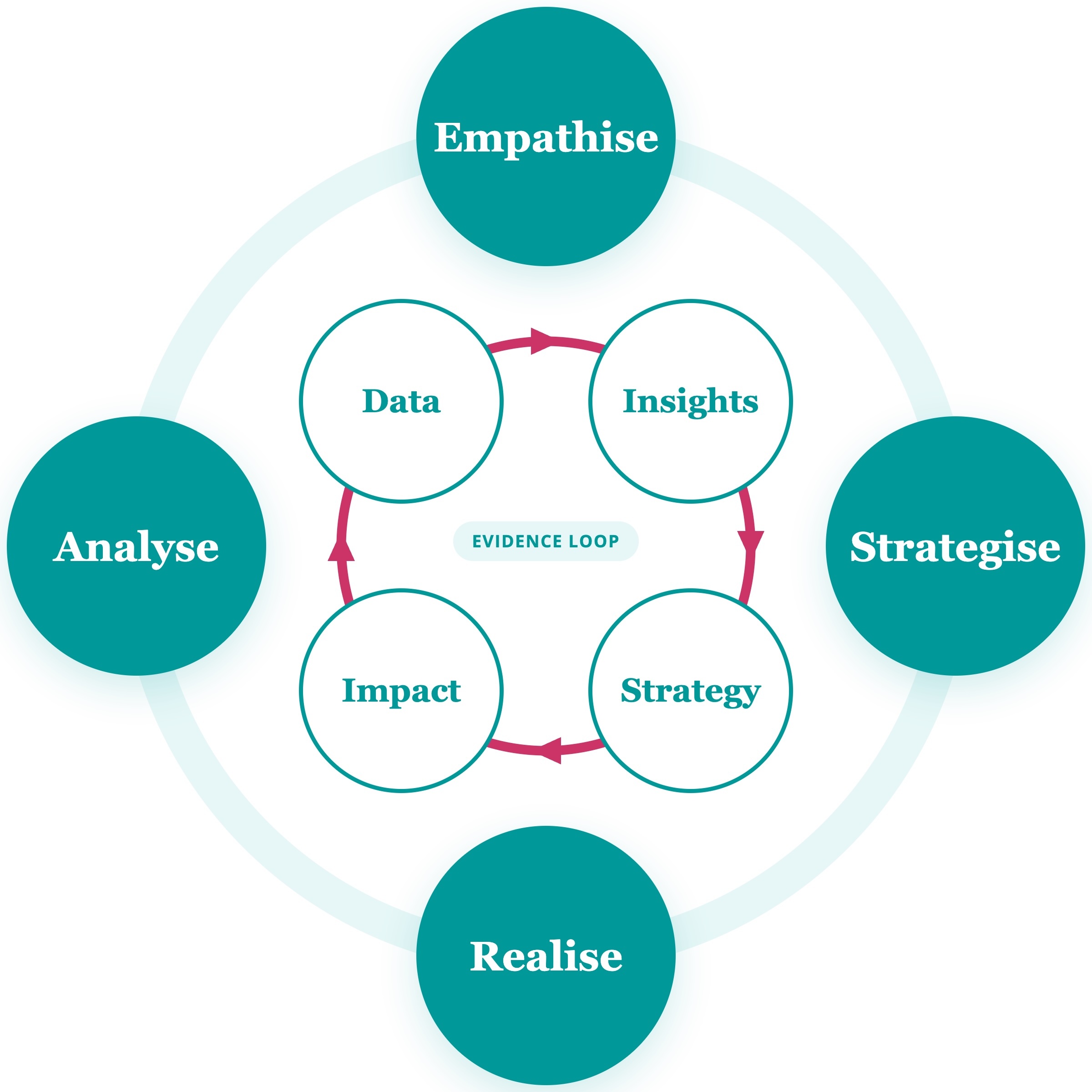
The People Centricity Methodology: Empathise, Strategise, Realise and Analyse around an engine turning Data into Insights, Insights into Strategy and Strategy into Impact.

Empathise in Define · Strategise in Define · Realise in Activate · Analyse in Prove

Empathise comes first for the reason set out above: no solution statement until there is an agreed problem statement, gathered top down and bottom up.

Analyse then returns to Empathise, and that return is the mechanism, not a flourish. A people strategy is a set of bets about what will move the business through people. Bets are only worth making if you find out whether they paid, and finding out is only worth doing if the answer changes the next set. Measure, correct, commit again.

Break that circuit at any point and you have either analytics that change nothing or a strategy that cannot learn — and both fail the same way, slowly and without anyone deciding to stop.

It is also why the three stages are one engagement rather than three. Prove exists to make Define better next year.
Explore the People Centricity Methodology™ →

Proof, not promises

Where this work has been done.

90 engagements across 30 organisations, led by the founder since 2006 — at PwC, at Deloitte, and now at PeopleCentriX.

Private sector

  • Audemars Piguet
  • AXA
  • Cargill
  • Cartier
  • DHL
  • Ferring
  • Galderma
  • GSK
  • Gunvor
  • Lingaro
  • Lombard Odier
  • Nestlé
  • Novartis
  • Pictet
  • Richemont

Public and international

  • Abu Dhabi Government
  • Belgian Railways
  • Eurojust
  • European Southern Observatory
  • Hôpitaux universitaires de Genève
  • International Committee of the Red Cross
  • International Labour Organization
  • International Organization for Migration
  • International Organization for Standardization
  • Medicines for Malaria Venture
  • The Global Fund
  • UN Refugee Agency
  • World Health Organization
  • World Intellectual Property Organization
  • World Trade Organization

3 engagements per organisation, on average. Almost none of them were won twice by the same pitch — they were renewed because the first piece of work held up, and because whoever commissioned it was still there to commission the next one.

Half our work is private sector. The other half is public and international — UN agencies, NGOs and intergovernmental organisations.

Each of them is specific. Expectations in a research institute are not expectations in a private bank, and neither are expectations in a humanitarian agency — and two organisations of the same size in the same sector often differ as much again. What people believe they were promised is local to the place they work, and to the moment they joined it.

Which is why we research expectations rather than assume them. A proposition built on assumptions imported from somewhere else is a promise made to people who were never asked.

Our case studies are anonymised. Client contacts are not — we share them on request.

Ask for a client introduction

Questions

Before you get in touch.

Who is this for?

Chief People Officers and CHROs in organisations of roughly 500 to 50,000 people. About half our work is private sector; the other half is public and international — UN agencies, NGOs and intergovernmental organisations, with engagements across all continents.

How is this different from your People Centricity work?

Scope, not rigour. People Strategy builds and governs the whole agenda and stays until the board has seen the return. People Centricity solves one thing precisely and then finishes. Same method, same evidence standard, different size of question.

What does it cost?

The cost is a function of the plan, and the plan does not exist until we build it with you. Which is exactly why Phase 0 exists: 4 weeks, scoped on its own, in which we co-design the methodology and the project plan. Everything after it is costed against that plan, and you see the number before committing to any of it.

So the sequence is: a conversation, then Phase 0, then a costed engagement. If the budget you have and the work you need are not compatible, the first conversation is where we would both rather find that out.

Why not a Big Four firm?

Sometimes you should. If the work needs 200 people in 12 countries by Monday, we are the wrong call and we will say so on the first conversation.

They have 20 or more service lines. We have 2. People strategy is one offering among many there, resourced accordingly. It is 1 of only 2 things we do.

There, a people strategy is often the way in. It is priced modestly because the implementation behind it is where the revenue sits. We hold no implementation practice, so there is no follow-on for our recommendations to bend towards. What we advise is what we think, because it is all we have to sell.

You get the team you met. In a large firm, staffing is a utilisation problem — the engagement is filled from whoever is on the bench. We do not have a bench.

And the people doing the work are trained to do it. Everyone here holds at least an MSc, with formal training in project and change management, in qualitative and quantitative method, and in design thinking. In a large firm the diagnostic is usually run by consultants trained in consulting, working from a benchmark database somebody else assembled.

The trade is scale for specialisation and continuity. If scale is what your problem needs, take scale.

We already have a strategy. Is Define wasted on us?

Often not, though the work changes shape. A strategy that was never built on an evidence base can be retrofitted with one, and that is usually faster than starting over — you already know what you want to do, and what’s missing is the case for why it’s right and the proof that it worked.

If the strategy is sound and the problem is momentum, start at Activate instead.

Who actually does the work?

A PeopleCentriX team, and the same one across all three stages.

We never subcontract and we never outsource — no associate network, no partner firm, nobody billed through us who does not work here. Which means our capacity sets a hard ceiling on how many engagements we run at once, and we would rather turn work down than staff it thinly. It is why we work with a small number of clients at any one time, and why the answer to when we could start is sometimes not now.

What happens if I get in touch?

A conversation, not a pitch. Most first calls are spent on your situation — what is breaking, what you have already tried, what your evidence is telling you. Some end with a proposal. Many end with a suggestion and nothing else.

Where does the research come from?

Named sources, every time. The people-and-performance evidence is Oxford’s Rethinking Performance Initiative — a systematic review of 21 studies from A and A+ ranked journals, covering operational as well as financial performance. The equity-market line is the separate Schroders–CalPERS–Oxford study of July 2023. The trend figures come from our 2026 HR Trends & Priorities Heatmap, free and fully sourced. The measurement approach descends from Jac Fitz-enz’s Saratoga practice: 2 metrics per initiative, each tested for relevance and for whether you can collect it.

Where a finding is correlational rather than causal, we say so — that one is.

Work with us

Bring us the problem before it becomes the board’s.

A people strategy fails in one of two ways. It is never really built — a list of initiatives standing in for a set of choices. Or it is built, approved, and then dies of attendance: the fortnight that became a month, the lead who was reassigned, the initiative nobody decided to stop.

Evidence prevents the first. Governance prevents the second. That is why we stay for all three stages rather than the first.

We work with a small number of clients at any one time.

Not at that point yet? Start with the Playbook — whether you are new to the seat or resetting a mandate that changed under you. Free, no form, and a better use of your time than a call you are not ready for.

Who’s behind this

Tanguy Dulac

Tanguy Dulac

Founder & Managing Partner, PeopleCentriX

PhD, Management Science — LSE / UCLouvain
MSc Applied Economics — UCLouvain
MSc Psychology — UCLouvain
Academy of Management Journal — cited 1,000+ times
Lecturer — Sustainable Human Capital Management, University of Fribourg
Lecturer — Human Capital Risk Management, HEG Genève

I have been building people strategies since September 2006. Not advising on them from a distance — building them, governing them, and being in the room when the board asks what they returned.

Fresh from my PhD that year I applied to one firm, PwC, for one reason: Saratoga, the practice Jac Fitz-enz built, where measuring the value people create was the whole job. 20 years later I am still asking his question in the form it now takes. A people strategy is only real once its value is measured, and the measurement has to feed back and correct the strategy. Analytics that change nothing are just reporting.

His measure has outlived the function it was built for. When Schroders, CalPERS and Oxford tested whether human capital predicts equity returns, the metric underneath the analysis was his — and in the organisations I work with that have no share price at all, the same discipline justifies a budget line against a mandate.

PeopleCentriX sells people strategy work, so this page is not disinterested. It is checkable. Every figure names its source, baselines are set before the work starts, and the method is published in full.

The case studies on this site are anonymised. The credentials behind them are not — ask and I will send the unredacted list.

If something here lands, or doesn’t, I would rather hear it than not.
tanguy.dulac@peoplecentrix.eu · LinkedIn

Stay Connected. People-Centric Insights.

Our quarterly newsletter is for leaders who make strategic decisions about people, strategies, and experiences. It contains curated content about trends, thought leadership, case studies, and events.